The specification says thirty minutes. The aircraft delivers twenty. That gap is behind a large share of precautionary landings and lost aircraft.
Why real endurance is shorter
Specifications are measured ideally. Hovering, no payload, no wind, moderate temperature, a new pack.
Wind. Flying into it costs substantially more, and holding position against it costs too.
Payload. A heavier camera or additional equipment reduces endurance disproportionately.
Manoeuvring. Acceleration and turns consume more than steady cruise, and a survey grid is mostly turns.
Temperature. Cold packs deliver less capacity. Hot packs perform poorly and degrade faster.
Age. A pack after a year of use may retain only eighty per cent of its original capacity.
Mandatory reserve. You cannot fly to empty. Enough must remain to return and land under control.
Practical rule. Take seventy per cent of the published figure as usable endurance, and less in difficult conditions.
Measure your own. After a dozen flights you will have a better figure for your aircraft in your conditions than any specification sheet provides.
Calculating requirement
Flight time needed for the task. From track length and speed.
Add climb and descent. A few minutes per sortie.
Add transit. If the launch point is distant from the working area.
Add reserve. Twenty per cent minimum for wind and the unexpected.
Divide by real endurance per pack. Giving the sortie count.
Add spare packs. At least one set, for a reflight or a pack that underperforms.
Charging time. If you do not carry enough packs for the whole task, field charging is required — and charging takes far longer than flying.
Power source. Generator, vehicle inverter or mains. Confirm before travelling.
Consider a second aircraft. For large tasks, flying one while the other charges is usually the most effective way to raise daily productivity.
Field discipline
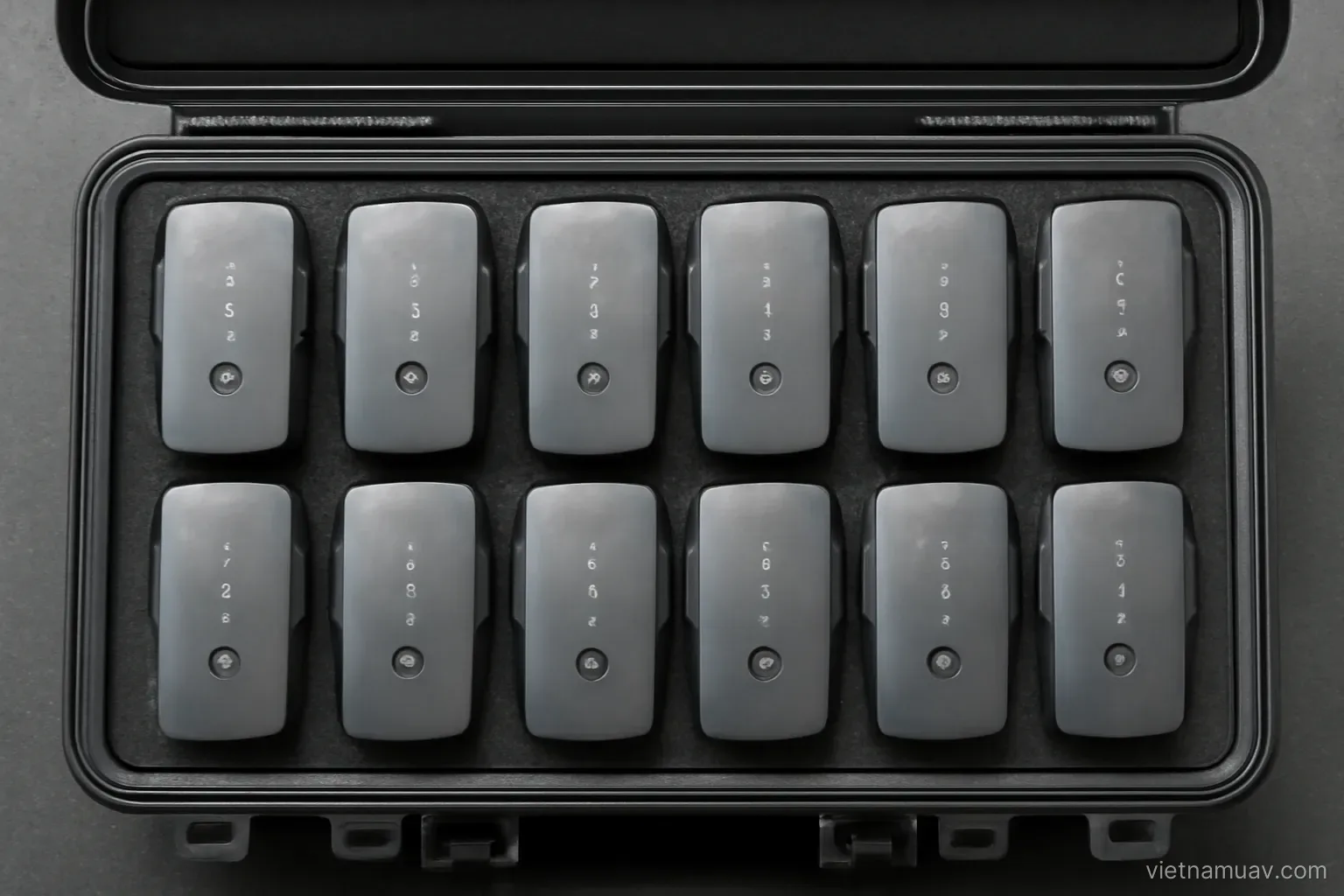
Number the packs. So you know which are charged, which are used and which are weak.
Separate them physically. Charged in one case, used in another. Fitting a depleted pack is a mistake that happens when rushing.
Check voltage before fitting. Rather than relying on memory.
Shade them. Packs in direct sun heat quickly. An insulated box or shaded position is enough.
Cool before charging. A pack straight from a flight is hot. Wait fifteen minutes.
Do not deep discharge. Land with reserve remaining. Deep cycling shortens life considerably.
Log cycles. Track the age of each pack and retire it before it causes a problem.
Inspect for swelling. Before every use. A swollen pack is withdrawn immediately.
Keep them secure in transit. Loose packs sliding around a vehicle are a genuine fire risk, not a theoretical one.
Monitoring during flight
Percentage is not linear. The last portion falls faster than the first.
Watch voltage. A more reliable indicator than percentage in the final stage of a flight.
Consider distance home. How long the return will take from the current position. Many systems show a warning based on this.
Set a conservative return threshold. Higher than the manufacturer default. Returning early is always better than returning late.
Account for wind on return. Flying out downwind means returning into it, which takes longer and costs more.
Do not dismiss low battery warnings. The aircraft is calculating from several inputs.
Land at the nearest safe point when needed. Do not attempt to reach the launch point on inadequate reserve. A controlled landing elsewhere beats a fall.
Record landing state. After several flights you will know how accurate your estimates are and can adjust.
Watch for a pack that behaves differently. A single pack draining faster than the others is telling you something before it fails outright.
Extending working time
Efficient flight lines. Fewer turns, less transit over already-covered ground.
Reduce payload. Remove equipment not needed for this task.
Optimal speed. There is a speed that minimises energy per unit area. Too slow wastes energy hovering; too fast wastes it overcoming drag.
Orient lines relative to wind. Where you can choose, run the long legs across the wind rather than into and out of it.
Launch close to the work. Transit produces no data.
Streamline battery changes. Packs pre-positioned, procedure practised. Saving two minutes per sortie matters over a full day.
Charge in parallel. Multiple chargers where power allows.
Second aircraft. The single most effective productivity measure on large projects.
Plan around the weather window. Working efficiently during the best three hours often beats spreading the same flying across a whole difficult day.
Frequently asked questions
How much of the published endurance is usable in practice?
About seventy per cent, and less in difficult conditions. Specifications are measured hovering with no payload, no wind and a new pack.
What is the most common battery mistake in the field?
Fitting a partially depleted pack when rushing. Numbering packs and keeping charged and used ones in separate cases prevents it.
Why is percentage remaining a poor indicator late in a flight?
Because consumption is not linear — the last portion falls faster. Voltage and distance-to-home give a more reliable picture at that stage.
What raises daily productivity most on large projects?
A second aircraft, so one flies while the other charges, combined with parallel charging where the available power supports it.
More in Airspace rules and permits and Search and rescue.