One survey flight produces tens of gigabytes. A year of commercial work produces tens of terabytes. Without a system, the moment you need to retrieve something from last season is the moment you discover you cannot.
Naming and structure
Decide once, at the beginning. Changing convention midway leaves two systems and both become awkward.
Date first. In a format that sorts chronologically without effort.
Then project or client. A short code, no spaces, no accents.
Then area or sortie number.
Avoid special characters. They cause problems in some software and on some systems.
Keep paths short. Very long paths break certain tools.
Consistent folder structure. Every project with the same subfolders — source imagery, control data, processing outputs, deliverables, documentation.
A description file in each project. A few lines on what it was, when it was flown, and under what conditions. Six months later you will need it.
Apply the same structure to archived projects. Consistency is what makes an archive searchable rather than merely large.
Backup
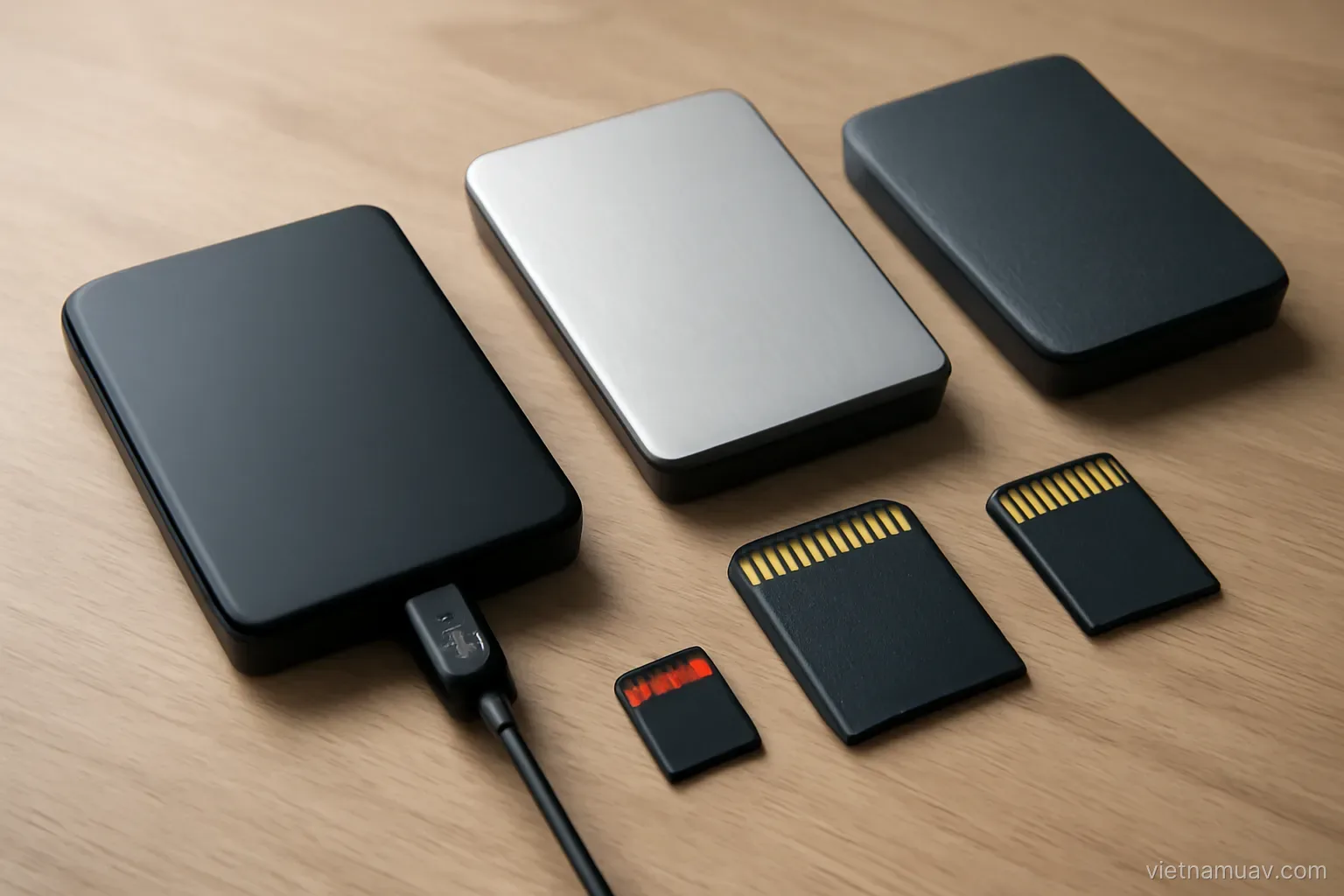
Three copies. On two different device types, with one stored somewhere geographically separate.
Back up on site. Before leaving. Card to at least one drive.
Do not clear the card immediately. Keep it until two copies exist and the data has been verified readable.
Verify the copy. File count and total size. Silent copy failures do occur.
Drives fail. Including drives sitting unused. Check them periodically and replace on a schedule.
Cloud storage. For the offsite copy. Priced by volume and dependent on adequate upload capacity.
Automate it. Backup that relies on remembering will eventually be forgotten.
Test restoration. Periodically retrieve something from backup. A backup that cannot be restored is not a backup.
Keep one copy offline. Ransomware and accidental deletion both propagate through connected storage, and an offline copy is the only defence against either.
Managing volume
Estimate before the project. Image count times file size, plus intermediate processing data and deliverables.
Intermediate data is large. Point clouds and meshes are frequently several times the size of the source imagery.
Classify by value. Source imagery is irreplaceable. Intermediate data can be regenerated. Deliverables must be kept.
Delete intermediates. Once the project is complete and accepted. This frees substantial space.
Compress source imagery. Where lossless compression is available for the format.
Long-term archive. Offline drives for old projects, cheaper than keeping everything on working storage.
Retention policy. How long data is kept. Agreed with the client rather than decided unilaterally.
Annual review. Which projects are old enough to archive or delete.
Label archive drives properly. An unlabelled drive in a cupboard is functionally the same as no drive at all.
Metadata and traceability
Image metadata. Position, altitude, camera orientation, time, exposure settings. Embedded in the file.
Do not strip it. Some editing tools remove metadata. For survey imagery, losing it makes the data unprocessable.
Aircraft flight logs. Recording the whole sortie. Needed for incident analysis and for some processing workflows.
Download and keep them. Frequently forgotten, and valuable information is lost with them.
Conditions. Weather, wind, light. Recorded manually because the aircraft does not.
Equipment. Which aircraft, which camera, which settings. Required when comparing datasets across time.
Control point information. Coordinates, survey method, accuracy, who measured them.
All of it in one description file. In the project folder. Simple, and it saves a great deal of time later.
Record the processing parameters too. Reproducing a result a year later is otherwise guesswork.
Security and rights
Flight data contains sensitive material. Client site layouts, images of people, condition of property.
Control access. Client data should not sit somewhere anyone can browse.
Encrypt portable drives. Drives that travel to site are the ones that get lost.
Agree terms with the client. Ownership, permitted use, publication rights, retention period, deletion method.
Put it in the contract. Unaddressed, it becomes a dispute — particularly around using imagery for marketing.
Ask before using material as a sample. Even attractive and apparently harmless imagery.
Delete when the term expires. Properly, not merely removing it from view.
Sensitive locations. Additional care over storage and sharing, with rules governing what imagery may be retained and published.
Know where every copy is. A deletion obligation cannot be honoured if nobody can list the places the data was copied to.
Frequently asked questions
What is the basic backup principle?
Three copies on two different device types with one stored geographically separately, plus at least one copy kept offline against ransomware and accidental deletion.
When can a memory card be cleared after a flight?
Only once two copies exist and the data has been verified as readable. Silent copy failures do happen and are only discovered when it is too late.
Which data is irreplaceable?
Source imagery with its embedded metadata. Intermediate processing data such as point clouds can be regenerated and deleted after project acceptance.
Why record processing parameters?
Because reproducing a result a year later — to answer a query or extend the work — is otherwise guesswork, even with the original imagery available.
More in Operations and safety and Airspace rules and permits.