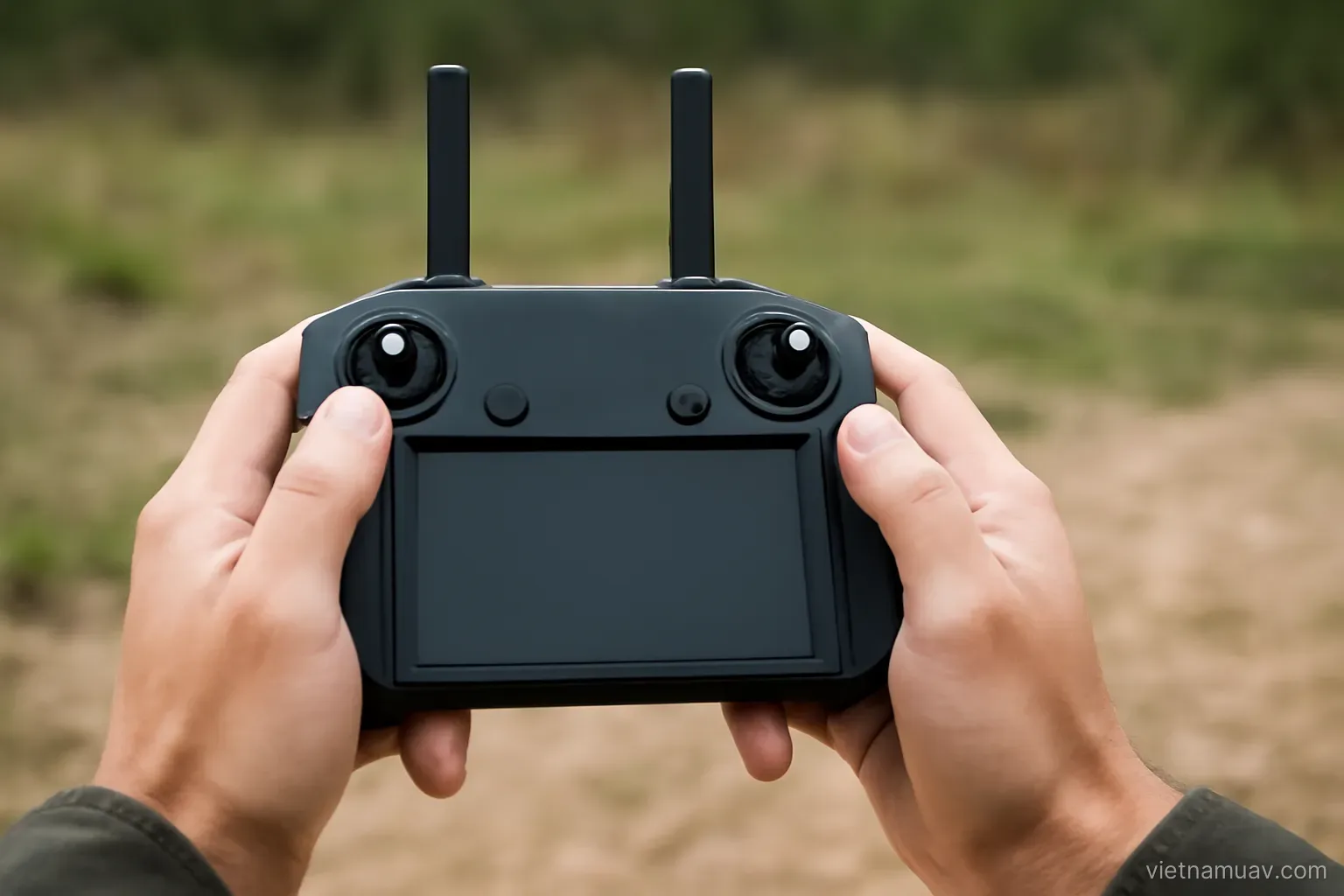
The only connection between operator and aircraft is a radio link. Understanding how it works, and how it fails, is directly connected to whether aircraft come home.
What is being transmitted
Control commands. Upward from controller to aircraft. Small in volume and the most critical.
Telemetry. Downward. Position, altitude, battery, warnings.
Video. Downward. By far the largest data volume.
Different priorities. Losing video is inconvenient; losing control is dangerous. Well-designed systems protect the control channel first.
Frequency bands. Shared with wireless networking and many other devices.
Band switching. Modern systems change frequency automatically when interference is detected.
Bandwidth against range. A trade. High-quality video consumes bandwidth and reduces effective range.
Reduce video quality when distant. Trading image quality for a more stable link is usually the right choice.
Latency matters too. A laggy video feed makes precise flying near obstacles genuinely harder, independent of whether the link is holding.
What limits range
Obstructions. The dominant factor. Hills, buildings and trees between operator and aircraft block the signal.
Line of sight. These frequencies travel essentially in straight lines. If you cannot see it, the signal struggles to reach it.
Interference. Wireless networks, transmission masts, high-voltage lines, industrial equipment.
Urban environments. Heavily degraded range compared with open country.
Antenna orientation. Antennas have strong and weak radiation directions. Pointing them wrongly loses the link at short range.
The common error. Aiming the antenna tips at the aircraft. The tip is the weakest direction. The flat face of the antenna should face the aircraft.
Body shielding. Standing with your back to the aircraft puts your own body in the path.
Operator height. Standing higher improves line of sight and often improves range more than any equipment change.
Weather has some effect. Heavy rain attenuates these frequencies, so range on a wet day is shorter than the same site on a dry one.
Weak and lost links
Early signs. Stuttering video, falling signal indicator, increasing latency.
Act immediately. Climb or bring the aircraft closer. Do not wait for total loss.
Adjust the antenna. Sometimes the fix is simply orientation.
Move position. To more open, higher ground.
On total loss. The aircraft executes its configured behaviour, usually returning to the launch point.
Verify that configuration in advance. Particularly the return altitude, which must clear every obstacle. This setting saves aircraft and is frequently left at default.
Do not panic. The aircraft usually returns. Keep the controller pointed toward it and wait for reconnection.
If it does not return. Record last known position and heading. Onboard logs frequently help locate it.
Check the home point is where you think it is. A home point recorded before the aircraft had a good position fix sends it somewhere unhelpful.
Flying beyond visual line of sight
Definition. Operating when the aircraft cannot be seen directly, relying entirely on the display.
Regulation. Generally subject to specific requirements and often special authorisation. Check what applies.
Why restricted. Without sight of the aircraft you cannot detect other traffic, see obstacles or assess the situation.
Risk increases sharply. A disproportionate share of serious incidents involve operations beyond visual line of sight.
Observers. Some frameworks permit extended operation with an observer positioned to see the aircraft and in communication with the pilot.
Additional equipment. Traffic detection systems, directional antennas, signal repeaters. For professional operations.
Large-area survey. Many projects genuinely require distance. Prepare the procedure and the paperwork properly.
Precautionary position. Without authorisation and appropriate equipment, keep the aircraft in sight. An incident beyond visual line of sight is difficult to defend on any ground.
Plan the return separately. Distance flying means the return leg is long, and it must be budgeted in energy as well as in time.
Improving link reliability
Choose the operating position well. High, open, unobstructed toward the working area. Simplest and most effective measure available.
Directional antennas. Concentrate energy in one direction, substantially extending range, but they must be kept aimed.
Amplifiers. Available on some systems. Check the regulatory position on transmit power before using them.
Avoid high-interference locations and times. Industrial areas and places with many transmitters.
Scan before flying. Some equipment reports which channels are congested.
Lower the video quality. Trading bandwidth for stability when operating at distance.
Keep firmware current. Manufacturers improve link handling over time.
Plan within the margin. Design missions so you never approach the limit of the link. Operating at around seventy per cent of achievable range leaves sensible headroom.
Test the range at each new site. Published figures assume open conditions that most working sites do not provide.
Frequently asked questions
What is the common error with antenna orientation?
Pointing the antenna tips at the aircraft. The tip is the weakest radiation direction — the flat face of the antenna should face the aircraft.
What should be done at the first sign of a weakening link?
Climb or bring the aircraft closer immediately, adjust antenna orientation, and move to more open higher ground. Do not wait for total loss.
Which setting most often saves an aircraft after link loss?
The return-to-home altitude, which must clear every obstacle between the flight area and the launch point. It is frequently left at the default value.
How much of the achievable range should a mission use?
Around seventy per cent, leaving headroom for wind, unexpected interference and any need to fly an unplanned detour.
More in Operations and safety and Flight planning.