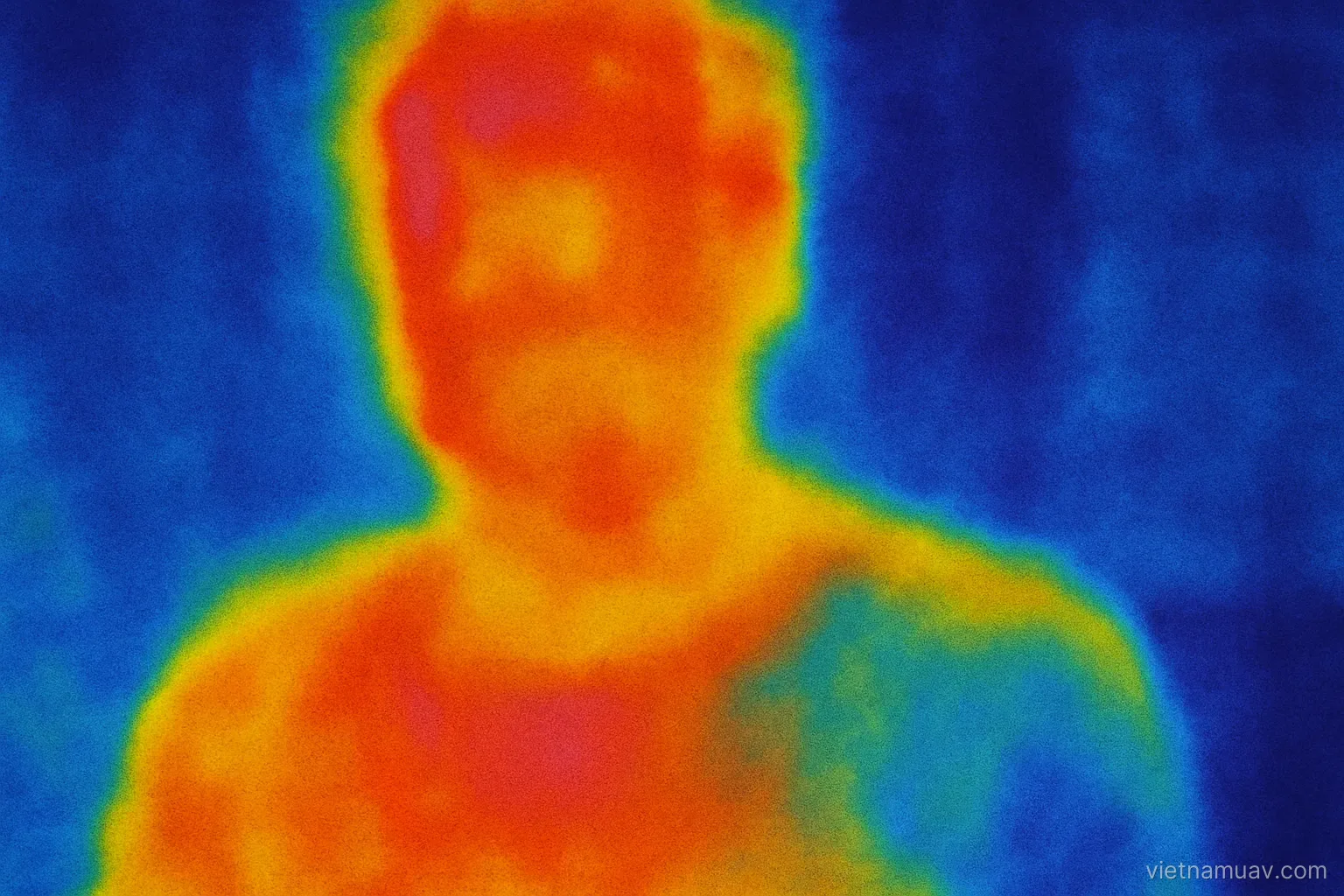
A thermal camera reveals a layer of information invisible to the eye. It is also widely misread, because thermal images look like photographs while describing something entirely different.
What the camera measures
Long-wave infrared radiation. Everything above absolute zero emits it, and intensity depends on temperature.
Surface temperature only. Not internal temperature. This is the single most important point and the one most often misunderstood.
Emissivity. Different materials emit differently at the same temperature. Polished metal has very low emissivity and produces badly misleading readings.
Reflection. Shiny surfaces reflect radiation from elsewhere, and the camera measures that reflection as well.
The practical consequence. Thermal images of metal roofing or stainless pipework are unreliable unless emissivity is properly accounted for.
It does not see through anything. Not walls, not glass, not water. Glass blocks long-wave infrared completely.
Low resolution. Thermal sensors carry far fewer pixels than visual ones, so small distant details are simply absent.
Two classes of camera. Those producing relative imagery and those measuring absolute temperature. The latter costs more and is required for measurement work.
Reading a thermal image
The colour scale is arbitrary. No colour is inherently hot or cold. Read the scale attached to the image.
Displayed temperature range. Cameras auto-scale to the scene. The same object can look completely different in two images with different ranges.
Fix the range when comparing. Mandatory if two images are to be compared meaningfully.
Look for differences, not absolute values. For most applications, a spot warmer than its surroundings is the information.
Consider the conditions. Sun heats surfaces unevenly, wind cools them unevenly, recent rain leaves everything cold.
Time of capture. Evening after sunset gives the cleanest results, because solar loading has dissipated.
Common false readings. Cloud shadow, wet patches, different materials adjacent to each other, sky reflection on shiny surfaces.
Wind changes everything. A breeze cools exposed surfaces unevenly, so a warm spot may simply be sheltered rather than genuinely hotter.
Always verify. Every thermal finding needs confirmation by another means before any conclusion is drawn.
Infrastructure inspection
Hot spots on power lines. Poor connections generate heat. Early detection prevents failures.
Solar panels. Faulty or shaded cells run hotter. An entire array can be checked in one flight.
Pipelines. Leaking hot or cold fluid leaves a thermal signature on the ground above.
Building envelope heat loss. Locating poorly insulated areas.
Moisture in structures. Damp areas have different thermal behaviour and show up during heating or cooling cycles.
Roof inspection. Water trapped beneath roofing retains heat differently from dry material.
Overheating machinery. Bearings, motors, gearboxes.
The general requirement. A temperature difference must exist to be visible. Inspect while systems are operating, or during a heating or cooling cycle.
Other applications
Wildlife and livestock counting. At night or in sparse cover.
Detecting smouldering fire. After a fire is knocked down, finding hot spots that could reignite. Genuinely valuable in wildfire work.
Mapping a fire edge. Through smoke that blocks visual observation.
Crop water status. Water-stressed plants close their stomata and run warmer, producing a map of areas needing irrigation.
Irrigation leaks. Buried pipes leaking leave damp, cooler ground.
Nocturnal search. Covered earlier.
Perimeter security. Detecting people in darkness around a protected site.
Environmental discharge. Water entering a river at a different temperature from the receiving body shows clearly, which makes outfalls easy to locate.
The common thread. Thermal is most useful for spotting anomalies against a relatively uniform background, not for examining fine detail.
Selection and operation
Resolution first. The most important specification. It determines what size of object can be detected at what range.
Calculate flight altitude. From thermal resolution, focal length and target size. Too high and the target occupies a single pixel, indistinguishable from noise.
Thermal sensitivity. The smallest temperature difference the sensor can resolve. Matters when the signal is weak.
Temperature range. Wildfire work requires a far higher range than searching for people.
Absolute measurement capability. Needed for quantitative inspection, unnecessary for simple detection.
Pair with a visual camera. Extremely useful for confirming and locating. Many payloads include both.
Warm-up time. Thermal cameras need to stabilise after power-up. Switch on several minutes before measuring.
Lens care. Thermal lenses use specialised materials with delicate coatings. Never clean them with an ordinary cloth.
Frequently asked questions
What exactly does a thermal camera measure?
Surface temperature, not internal temperature. And it sees through nothing — glass blocks long-wave infrared completely, as do walls and water.
Why are thermal images of metal roofing unreliable?
Polished metal has very low emissivity and reflects radiation from elsewhere, so the camera measures reflection rather than the surface's own temperature.
Why must the temperature range be fixed when comparing images?
Because cameras auto-scale to each scene, so the same object can look completely different in two images taken with different ranges.
Which specification matters most when choosing a thermal camera?
Resolution, since it determines what size of object can be detected at what range and therefore sets the maximum useful flight altitude.
More in Operations and safety and Airspace rules and permits.